

Firmware Engineering
Embedded firmware development & system architecture
Firmware Is the Operating System of Your Product
Modern electronic products depend on firmware far more than on raw hardware. Once a device enters the field, firmware determines everything from sensor accuracy and wireless stability to boot reliability, security posture, and battery life.
At Techshlok, we treat embedded firmware not as application code, but as a system of coordinated layers that must behave correctly under load, noise, power variation, updates, and long-term operation. Whether you're building a bare-metal MCU device, a Linux-based gateway, an Android HMI, a multi-radio IoT platform, or an AI-enabled edge product, our objective is consistent: your device should behave correctly every time it powers on, updates, and interacts with the real world.

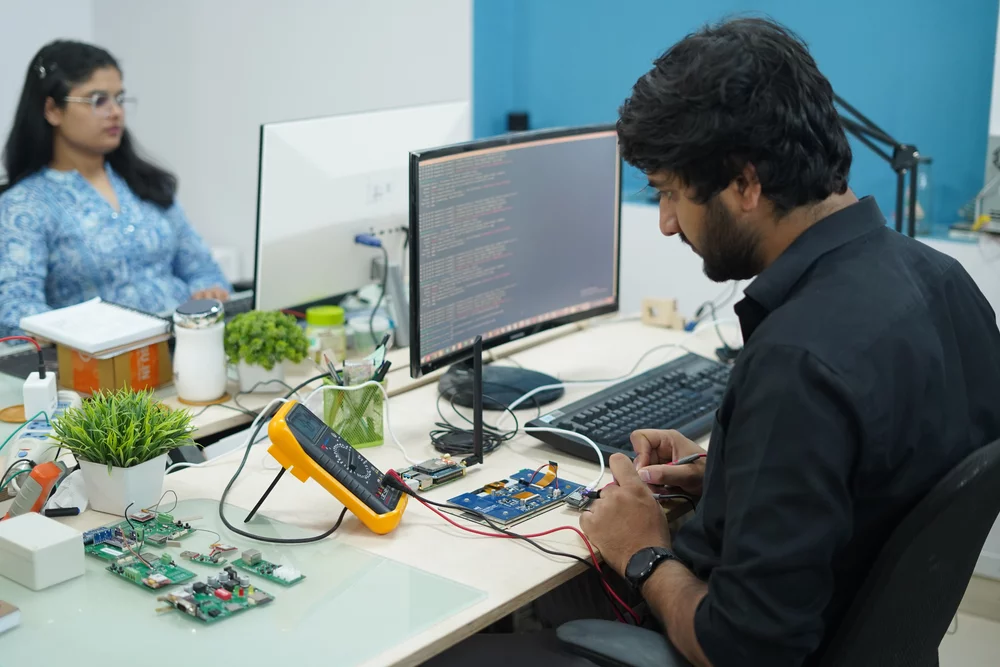
Debugging a LoRa module against system logs
Why Embedded Firmware Fails in the Field
Failures rarely come from a single defect. They emerge from architectural breakdowns — timing collisions, memory pressure, stack overflows, race conditions, RF contention, or hardware-firmware mismatches.
Our Firmware Domains
MCU Firmware (Bare-Metal & RTOS)
Deterministic control loops, ISR design, scheduling frameworks, and safety mechanisms for STM32, MSP430, C2000, and ESP32 microcontrollers in industrial, medical (non-diagnostic), automotive, and IoT systems.
Embedded Linux Firmware
Custom kernels, BSP bring-up, device drivers, Yocto/Buildroot distributions, networking stacks, and system services for gateways and edge compute platforms.
Wireless Stack Firmware
BLE, Wi-Fi, LoRaWAN, Zigbee, Thread, and cellular firmware with coexistence tuning, low-power optimization, provisioning flows, and reconnection logic.
Bootloaders & OTA Systems
Secure boot chains, DFU flows, A/B updates, rollback strategies, encrypted OTA pipelines, and manufacturing provisioning.
Edge AI Firmware
Optimized inference loops, sensor fusion pipelines, and real-time AI workloads running on MCUs, DSPs, and edge accelerators.
Middleware & Protocol Stacks
MQTT, Modbus, CANopen, OPC-UA, and custom communication layers enabling interoperability and distributed system behavior.
Platforms & Silicon We Work On
Firmware experience spans the following microcontroller and processor families:
Microcontrollers
- STM32 series
- TI MSP430 series
- TI C2000 series
- ESP32 series
Processors
- TI AM62x series
- Rockchip RK32xx series
- NXP i.MX8 series
- Raspberry Pi
Engineering Principles That Govern Every Firmware Project
Hardware-Aware Drivers
designed from real electrical behavior, not assumptions.
Event-Driven Execution Models
state machines over blocking logic.
Deterministic Memory Discipline
static allocation, bounded buffers, predictable stacks.
Cross-Layer Coordination
RF, sensing, OS tasks, and cloud flows designed together.
Secure Execution Paths
secure boot, key handling, encrypted channels.
Lifecycle Maintainability
logging, diagnostics, versioning, and upgrade safety.
Our Firmware Engineering Process
Platform Definition & System Boundaries
We map every subsystem the firmware must coordinate — sensors, radios, power states, memory, drivers, cloud interfaces, and UI — defining timing, resource, and upgrade constraints.
Architecture & Execution Model Design
Scheduling, concurrency rules, memory strategy, interrupt handling, power transitions, and OTA flows are defined upfront to remove ambiguity.
Platform Bring-Up & Driver Layer
MCU, Linux BSP, HAL drivers, kernel modules, and low-level interfaces are validated against real hardware behavior.
Application & System Integration
Business logic, middleware, and cloud communication are implemented within defined architectural limits.
Reliability & Field Simulation
Timing stress, RF edge cases, power cycling, OTA failure modes, and long-duration operation are validated.
Release Engineering & Lifecycle Support
Versioning, diagnostics, update pipelines, and long-term maintenance protocols prepare the product for scale.
What You Receive
You don't just receive firmware binaries. You receive a maintainable system:
Why Techshlok for Embedded Firmware
Hardware + Firmware Co-Design
Drivers and timing aligned to real electronics.
Architecture-First Engineering
Systems designed to scale, not patched to survive.
Proven Patterns Across 80+ Products
Fewer surprises, faster certification.
Field-Reliability Focus
Firmware designed for years, not demos.
Documentation That Scales
Onboarding, audits, and long-term evolution supported.
Predictable Execution
Reduced risk for startups, traceability for enterprises.
Who This Service Is For
Standards & Validation
Firmware architecture and process are designed to the following standards and practices:
Software Safety
- IEC 62304
- ISO 26262 (ASIL)
Code Quality
- MISRA C
- Static analysis (AppScan)
Process
- Unit test coverage
- Requirements traceability
- STQC (software side)
Firmware Reliability Checklist
- Has OTA rollback actually been tested, not just implemented?
- Is a watchdog implemented at the right layer, and does it verify real subsystem health?
- Is diagnostic logging in place before the product ships, or only after the first field issue?
- Is there a defined degraded-mode state, not just nominal / failed?
Deterministic firmware behavior is a specification, not an accident.
Build firmware that behaves predictably from prototype through scale.
Let's review your system architecture and define the right firmware strategy.